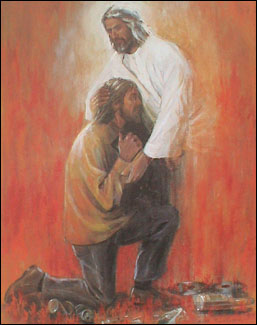
Miracle Prevention

And He did not do many miracles there because of their lack of faith.
–Matthew 13:58

          What a sad verse of scripture! Sadder still is the fact that it describes the prayer life of many Christians.  Oh, they see answers to prayer from time to time, and they give God the thanks He is due for them, but the daily experience of walking with God and taking every need, big and small, to Him and seeing Him answer–this is foreign to them.
          Not just individuals, but families and churches can be like that.  Rarely seeing a powerful move of God.  How sad it is when a church accomplishes little or nothing that couldn’t be accomplished through human strength.
          Matthew 13 tells us that this lack of seeing God move is not the result of any deficiency in God’s love, His character, His power, or His willingness to do things that will bring glory to His Name in our lives.  It is because of a simple lack of faith.  God does some miraculous things where faith is absent, but not as many as He would like to do.  There is no surer way to prevent miracles than to have no faith that God can or will do them.
          Individuals, families and churches that are great in faith, however, see God move greatly and often.  At the end of every day, a man or woman of strong faith will be able to go to God and say, “Father thank You for answering these prayers and meeting these needs today,” and then list quite a few.  Brothers, I am convinced that this is what the Christian walk is supposed to be–a life of faith so strong that the praises for God’s miraculous blessings continuously outnumber the cries to Him for help, because those who walk in strong faith and utter dependence on Him see Him act in their best interests again and again and again.  Each time He moves, His Name is given glory, and our faith increases all the more.
          The mature Christian is pleased when God moves; the immature Christian is surprised.  The mature Christian walks by faith; the immature by sight.  The mature Christian is quick to trust in God’s promises; the immature trusts the promises only after they are proved.  Which is your experience?  Do you see God working throughout your day, or just occasionally?  How many prayers do you see answered in a week?  Two or three?  More?  Less?  God does not do much for those whose prayer lives are characterized by “lack of faith.”
          Problem is, it’s very difficult to develop strong faith.  It’s difficult because we try to develop faith by conjuring it up out of our own willpower and strength.  Trying to create faith by our own efforts is a lost cause.  It is not the flesh that creates faith, but the Spirit and the Word.
          When we realize our faith is deficient, we must look to Jesus Himself to strengthen it.  Like the man who sought a miracle from Him and said, “I do believe.  Help me overcome my unbelief.” (See Mark 9)  This man understood that in his own heart, he had some faith, but was lacking great enough faith to believe in Christ’s power and trust in His willingness to meet a need that could only be met supernaturally.  So he confessed that lack of faith and asked for a greater measure of faith.
And Jesus gave him that.  Miraculously freeing his son from a demon, Jesus proved Himself in a way that could not help but strengthen the man’s faith.  You see, we are not the author and perfecter of our faith; Jesus is. (Heb. 12:2)  He is the one Who creates our faith, inspires our faith, grows our faith, develops our faith, and completes our faith.  Don’t just rely on the insufficient faith you can develop in your own strength; humbly turn to Him in prayer asking for stronger faith.  Ask Him to bring about whatever circumstances (even trials) that are necessary in your life for the building up of your faith.  Turn to God’s word, planting it in your heart continually, so that it will yield a crop of faith.  This is an essential of Christian growth, and an aspect of Christian maturity that many fail to attain for far too long.
Let the Lord make your faith grow; and learn to pray expectantly. Then your epitaph will not read, “Jesus did not do much in this person’s life, because of a lack of faith.”


Being Identified with Christ

The Bible message from the church this morning was on “Being Identified with Christ” from Luke 22:31-38. You can hear it here.

The Whole Bible in a nutshell?


So what is the Bible really all about? Is there a single theme—a major message—that can be worded concisely, to help someone quickly understand the point of God’s message for us?
Perhaps the point is: “Be good. God is watching.” Or maybe, “Be unselfish to please others, and you’ll be happy.” Or something like, “It will all work out in the end. Justice will prevail, with bad people punished like they deserve, and good people rewarded the same.”
Well, those are some ideas of what people might think the Bible is about, but they all miss the real point.
The good news is we don’t have to guess. Because the Bible already provides an accurate summary description of itself. Calling itself “the Scriptures,” in a passage Paul wrote, the Bible has this to say about just what God’s most important truth is: “For I delivered to you as of first importance what I also received: that Christ died for our sins in accordance with the Scriptures, that He was buried, and that He was raised on the third day in accordance with the Scriptures.” (1 Cor. 15:3-4)
That’s the bottom line. That Christ died for our sins, and rose from the dead. It was prophesied in the part of the Bible written before it happened, and it is the banner theme of the part of the Bible written afterward. Christ died for our sins, and rose again.
Notice that it doesn’t just say He died and arose. A lot of nice, religious people know He did that, but still don’t get the point of the Bible, and still don’t have a relationship with God. You need to understand WHY Jesus died to know what God is saying. He died “for our sins.” He didn’t die to found a religion. He didn’t die to set an example of sacrificial living that will please God. He didn’t die for “original sin” or for “the sins of Adam.” He didn’t die to show you how to live, and He didn’t die to show you how to die.
He died for your sins.
He died in your place.
Now, whether you’ve ever read the Bible or not, you already knew all about sin. It’s the reason you lock your doors before going to bed at night. And you already knew that you are a sinner. It’s the reason you wouldn’t want anyone to know about a lot of the secrets you keep.
And when you stand before God, God wants you to know that He isn’t okay with the fact that you have sinned. He isn’t willing to overlook even one of your sins, much less the whole load of them you’ve built up over a lifetime. God is holy. He is perfect. He is totally righteous in all He does. And He will not accept even a little bit of sinfulness into heaven under any circumstances.
But He loves you and me, and wants us to live with Him forever, even though we can’t if there are any sins on our record.
So He did what was necessary to satisfy both His righteous justice and His merciful love. He became a Man—the Man Christ Jesus. He lived a perfect life in our place. And then, even though there was no guilt in Him, He died on the cross. He died for our sins. The Bible had said He would hundreds of years before He came. And in accordance with the Scriptures, He did just what He had promised. He died for our sins.
That means He absorbed all of the punishment of God that we deserve for our sins. So that God could justly punish all of our wrongs, big and small, and still forgive us. Even though we can’t earn the forgiveness for ourselves. He earned it for us by not sinning and by taking the punishment in our place.
But He didn’t just die for our sins—He also came back to life. Because of that, He can be our Savior today, and give to us the eternal life in heaven that He earned in our place by living a perfect life.
You already knew you have sinned. You already knew sin deserves punishment. Now, thanks to God’s word in the Bible, you also know that you can escape the punishment you deserve because of what Christ has done for you.
That’s the message of the Bible for you, in a nutshell. And you must respond to it by personally trusting Christ as your Savior, in order to receive the benefits of Christ’s death in your place. Just knowing about it isn’t enough. You have to make the decision to trust in Christ alone to save you, and commit yourself to that belief. Those who don’t trust in Christ alone as their Savior will die with their sins unforgiven, and they will go to hell for eternal punishment.
Come to Jesus today for salvation. Tell Him you believe you have sinned and deserve punishment. Tell Him you believe that He loves you and died in your place on the cross. Tell Him you are trusting in Him alone to forgive you, cleanse you of sin, and give you eternal life in heaven, just as He promised.
Indeed He does promise that to everyone who comes to Him believing that message. The message God wrote for you in His word. “Christ died for our sins… and He was raised.”

Refreshing the Heart of God


“Like the cold of snow in the time of harvest is a faithful messenger to those who send him; he refreshes the soul of his masters.”
–Proverbs 25:13

In the oppressive heat of late summer, work in the fields under the sweltering sun can become all but unbearable. If you’ve experienced that before, you’ve probably known moments of daydreaming about how wonderful it would feel if for a moment you could have a breeze as cold as the winter air that brings snow. How refreshing that would be!
Solomon’s proverb above describes that refreshing as what it feels like to be a sender of a message, and to find the messenger was faithful to get the message through in a timely manner, accurately presented, to the people you have sent him.
So think about this: As followers of Christ, we have been sent by God with His message of reconciliation to the world of people who need Him.
Let’s be faithful messengers. Let’s make it our priority to go where He sends us, without delay or distraction. Let’s show up where He sends us in the time of His open door. Let’s be faithful to walk with Him in a way that makes us effective proclaimers of His word. Let’s be careful to proclaim it clearly, accurately, boldly, and in love. And let’s be faithful to open our lips to share the gospel every time He wants us to do so.
A faithful messenger refreshes the soul of the one who sent him. If you and I are faithful in the task we’ve been given to deliver His message, we can please God that way. Ask God today to make it the deepest desire of your heart to please Him so.

We won’t just disappear at the rapture


“For this we declare to you by a word from the Lord, that we who are alive, who are left until the coming of the Lord, will not precede those who have fallen asleep. For the Lord Himself will descend from heaven with a cry of command, with the voice of an archangel, and with the sound of the trumpet of God. Then the dead in Christ will rise first. Then we who are alive, who are left, will be caught up together with them in the clouds to meet the Lord in the air, and so we will always be with the Lord.” –1 Thessalonians 4:15-17

With Bible prophecies beginning to unfold right before our eyes this month (if you’re watching what Russia and Iran are up to in regard to Iran’s plans for Jerusalem), it is apparent that more than ever before, we seem to be close to the coming of the Day of the Lord.
As the Body of Christ, for us that means looking forward to what is going to happen to us as God begins to bring that Day upon the world: the event we call the Rapture of the church.
(Speaking of that, if you’ve had conversations with Christians who don’t believe Bible prophecy is literally true, they may have tried to prove their point at some time by saying, “The word ‘rapture’ doesn’t even appear in the Bible.” Well, actually, it does. You see the word rapture is derived into English from the Latin word that means ‘catching up’ or ‘snatching up.’ When we say, “the rapture,” we are literally saying “the catching up.” Which is the exact terminology the Bible uses in 1 Thessalonians 4 to describe the event we usually entitle “The Rapture.” In fact, if you get a Bible in a Latin-based language like Romanian, the actual word “raptured” will be used, where your English Bible says we will be “caught up” in that passage.)
Anyway, though, as we look forward to being raptured, let’s take a moment just to imagine what it will be like. Sometimes in books and movies the event is shown as people just suddenly vanishing, unexpectedly even to them. Suddenly driverless cars crashing and mass mayhem, and the like. (The Left Behind series even had them disappearing from their clothes which fell to the ground.) But is that what is described in the Bible passage above? Hardly.
Now, the Bible does describe our being changed in an instant and being made like Him instantaneously when we see Him, so that our mortal bodies become clothed in the immortal. But that instant is just one piece of the event of the rapture. The event itself isn’t instantaneous, and has a chronology described in the Bible.
Look at the chronology in the passage above of what will really take place. The first thing you’ll notice is that Christ will come for us, and we will be aware of His arrival. He will shout, and we will hear Him, along with the sound of a trumpet and the archangel’s voice announcing Him in some way. And even if the lost world doesn’t hear Him, too, we will still realize He is here and have time in our minds to understand that He has come to call us to Himself. We won’t just suddenly be gone.
Then, after we hear His coming, and perhaps see Him with our eyes, too, before we are caught up, the dead in Christ will rise. All those who have gone to the grave in faith in Christ whose souls have returned with Him in the skies, will receive their resurrection bodies first, before our uprising. Perhaps we will visibly see their resurrections, since it will be a bodily resurrection, just like Christ’s, who was the first to experience this permanent resurrection from the dead. At any rate, some interval of time, brief as it may be, will pass between our realization that He is here for us, and our rapture.
Then, we who are alive in Christ and remain on the earth will be caught up to be with them in the air. We won’t just disappear; we will physically rise up into the sky—the literal sky above the earth, complete with clouds for us to touch. And perhaps the lost people around us being left behind will actually see us rise, not just see us vanish. Because we will, whenever we are changed, still have a physical resurrection body. And it will probably rise in just the way Christ ascended into heaven, when His disciples watched Him flying up, up, and away, and actually saw Him go into a cloud so that He was then hidden from their vision.
The way the Bible tells the event, it is so much more glorious and exciting than the way internet videos portray it, where we’re suddenly just gone. We won’t just disappear. We’ll hear the voice of our precious Savior calling. We’ll stop whatever we’re doing. We’ll hear the celebratory trumpet call. We’ll hear the archangel’s proclamation. We’ll see loved ones who have died in Christ rise again. Then we will be picked up, changed, and fly into the skies to be with the Precious One for whom our hearts beat forever. It will be the most thrilling and fulfilling experience we’ve ever had, and one we should look forward to with eager anticipation.
Maranatha!
“Behold I am coming soon!”

On a side note, the “one will be taken and the other left” passage about Jesus, if you read it in context, isn’t talking about the rapture, but His return to the earth to judge the earth, which will happen later. In that passage, the “taken” ones are taken away to be condemned. That passage, then, shouldn’t be confused with a description of the rapture of the church, leading to a misunderstanding that we’ll just “disappear.”

Watch Your Mouth!

The message from the church this morning was on Ephesians 4:25-5:2, and it looked at how God requires us as followers of Christ to treat one another and speak to one another, as well as how He enables us to obey the high standards of behavior He requires of us. The audio, in English and Romanian, is available for your listening here.

Repentance Defined

Repentance unto salvation is a turning, but not a turning from sin per se. Repentance unto salvation is turning from your self-righteousness and self-justification to come to Christ, confessing that you are a sinner deserving judgment. It is ceasing to believe in the worth of yourself, your goodness, your good works, or your religious activities, and turning instead to trust only in what Christ has done on your behalf to save you. It is acknowledging that faith in Christ alone is really the only thing you have that you can offer to Christ, and the only thing from you He would accept.
It is not turning from sins to receive forgiveness for your past. It is admitting your utter inability to do so, and trusting God to be as merciful as He says He is, so that He will forgive you, even though in your own strength you absolutely cannot turn yourself away from your sins or your sinful nature to follow Him.
And, of course, the only basis upon which God can grant that unearned forgiveness, is that Christ actually did earn it for you, by living a perfectly sinless life in your place, and then dying in your place on the cross, absorbing the punishment you earned, and rising from the grave alive again to save you forever.

What is repentance? “Turning from sins”? No

To many preachers of what is supposed to be the gospel today, repentance means a change in behavior rather than a change in beliefs that allows God to save someone and then Himself cause a change in the heart and the behavior of the redeemed one. When Paul was called upon to summarize the gospel, though, he didn’t even mention the behavior of those being saved, except to say that their behavior was inherently bad, but that Christ died for our sins and rose from the dead. He determined to focus on nothing in his preaching to us except Jesus Christ and Him crucified, because that is the source–the sole source, in fact– of our righteousness.
But when the preachers of today fundamentally misunderstand the meaning of repentance, they wind up defining the gospel’s invitation, not in terms of the cross or of responding to God’s grace in belief, but instead summarize their invitation with something like, God “loves those who turn to Him in repentance, and loves those who cleanse themselves.” Problem is, that isn’t just a random quote. It’s a quote from the muslim Koran, and devout muslims believe it and live by it. But it doesn’t save them. They deny Jesus even died on the cross, which is why they view God’s grace as unnecessary for salvation.
Today, though, there are too many Christian preachers who are truly saved, but who for others change the rules on how to be saved, because of their unwillingness to understand what it means to repent, making it mean something that they can evaluate about the person’s behavior, instead of just a change of heart and belief and trust in Christ.
Perhaps what we need is to hear the words of someone who came out of that “turn away from sin and be good and God will accept you” mentality, into true saving faith in the true and living God.
Ergun Mehmet Caner is such a man. Born and raised a Sunni Muslim in the middle east, he was a believer in that religion not just by birth, but by choice, and he firmly believed in it, even willingly coming to America with his family in the hopes of turning it into a muslim nation submitted to Allah. But after years of trying to persuade him, a Christian friend finally convinced him that Jesus is the true Son of God and the true road to salvation. Caner describes the night of his salvation in a way that will help those who think repentance means “turn from your sins and God will forgive” to understand what it really means. Here are his words:
“For the first time in my life, I came to God with nothing in my hands to try to please Him. I brought nothing but my own repentance and my faith in Christ. Repentance itself is not a ‘good work’ that earns God’s approval. It is surrender–throwing oneself on the mercy of the court. Repentance for me was the end of works. It was an admission that everything I’d ever attempted in an effort to please God had failed. I finally saw that all my works, my best days, my righteousness, were as filthy rags. I threw myself on the mercy of the court. And Jesus declared me righteous, He declared me justified, and He saved me forever.”

August quote of the month

“Man requires God, whether He exists or not, because in His absence Man becomes a devil.”
–Vox Day

The line is the closing of a chapter from the book “The Irrational Atheist,” in which chapter the author very convincingly shows that both in our modern world and throughout history, atheistic morality in government produces oppression, violence, and mayhem greater than that produced by the adherents of any religion, (even Islam, which is intentionally violent and oppressive).